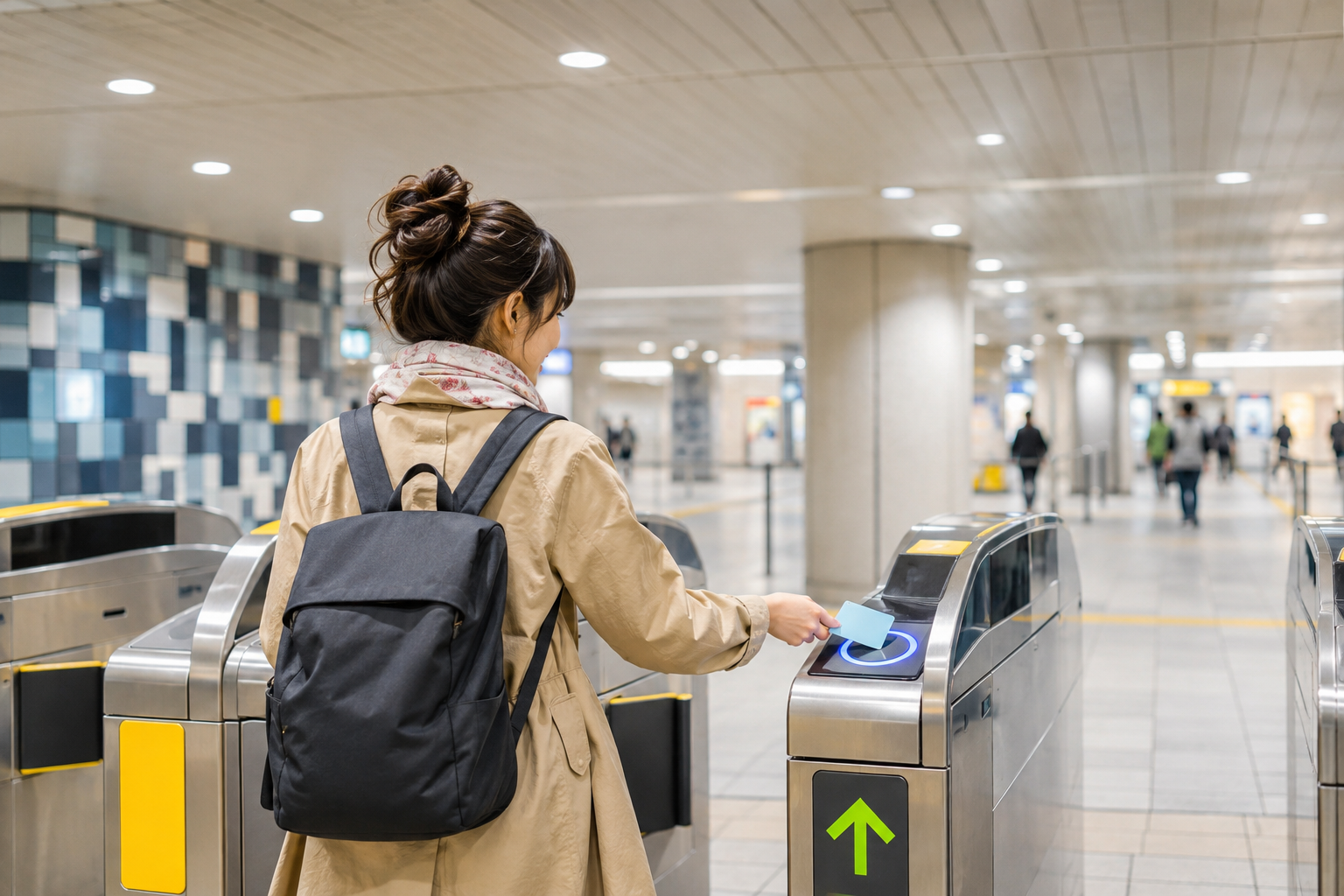
Featured image: AI-generated editorial illustration, not an actual photograph of Nagoya subway.
New to Nagoya’s subway? This guide explains how to buy a ticket, use an IC card, choose the right train and recover from common mistakes, with links to official information.
Official transport information in English
Prefer English-language resources? Start with the official Visit Nagoya guide to local transport, tickets and IC cards (English) or the Nagoya Transportation Bureau multilingual bus and subway guide (includes English; PDF). Some detailed operator pages linked below are in Japanese; use your browser’s translate feature if needed. Always confirm current fares and ticket rules with the operator before traveling.
How to ride the subway in five steps
1. Find the subway entrance and check the station name and exit number. 2. At the ticket machine, check the fare chart for your destination and buy a single ticket, or use a supported IC card. 3. Insert the paper ticket at the gate and take it back, or tap the IC reader. 4. Follow the line name, color, station number and direction shown on signs. 5. At your destination, exit through the gate; a single-use paper ticket is normally collected. Nagoya Transportation Bureau: first-time subway guide (Japanese; use browser translation).
How much is a single ride?
The official adult subway fare bands are ¥210, ¥240, ¥270, ¥310 and ¥340, depending on travel distance. The fare is not the same for every trip. Check the ticket machine or official fare guide for your exact origin and destination. Official fare table (Japanese; use browser translation).
Can I use Suica or another IC card?
Yes. The Transportation Bureau lists manaca and interoperable cards including Suica, PASMO, ICOCA and TOICA. Tap the card once at the entry gate and again at the exit. If a gate refuses the card, do not force your way through; ask the station staff. Keep multiple IC cards separate while tapping to avoid reading errors. Official ticket and gate instructions (Japanese; use browser translation).
Which day pass is worth buying?
Nagoya’s official tourism site lists a subway 24-hour ticket for ¥760 for adults and a city bus + subway one-day ticket for ¥870. These are different products: the subway 24-hour ticket is valid for 24 hours from first gate use, while a calendar-day pass has different conditions. Do not assume either covers Meitetsu trains, the Aonami Line or other private railways. For weekends, public holidays and the eighth of each month, also check the Donichi Eco Ticket (¥620 for adults), which covers city buses and the subway under its own date rules. A single round trip may cost less than a pass; compare the cost of your actual trips before buying. Visit Nagoya: getting around.
Important: buy a 24-hour ticket on the day you first use it
There is a difference between 24 hours of travel after first use and when you must start using a ticket bought from a machine. The Nagoya Transportation Bureau says a subway 24-hour ticket purchased from a station ticket machine must be first used by the end of subway service on the day of purchase; otherwise it becomes invalid. If you need a ticket for a later day, ask at a service center or station counter rather than buying an advance ticket from a machine. The official traveler ticket machines sell same-day tickets only. Official traveler ticket machine rules (Japanese; use browser translation).
How to buy a discounted ticket on an English-language machine
On supported touch-screen ticket machines, select English → Ticket → Discount Ticket, then choose the ticket type and number of travelers. The available products depend on the date: the Weekend Eco Ticket is for Saturdays, Sundays, holidays and the eighth of each month. Always read the conditions shown before paying. Official discount-ticket information (Japanese; use browser translation).
Can I use a contactless credit card at the subway gate?
Yes. Since September 3, 2026, contactless bank-card entry has been available at all Nagoya subway stations. Supported brands include Visa, Mastercard, JCB, American Express, Diners Club, Discover and UnionPay. Look for the marked contactless bank-card reader on a compatible gate: not every gate has one. Tap the same card or device when entering and exiting, and wait for the reader to confirm. A compatible smartphone or wearable may also work. This is different from paying at a ticket machine with a QR-code payment app. Check the official contactless payment instructions (Japanese; use browser translation) and Visit Nagoya’s English transportation guide.
Illustration note: Any accompanying AI-generated subway-gate image is illustrative, not a photograph of a particular Nagoya station or its exact gate hardware.
Contactless card pitfalls: the same device, one traveler per card
Contactless bank-card travel works across Nagoya’s municipal subway stations, but it has important restrictions. Each traveler needs their own eligible card or device. If you tap a physical card to enter, do not switch to the same card in your phone wallet to exit: the system requires the same physical payment medium at both ends. Some gates do not yet have a dedicated reader; ask station staff if you cannot find one. The service is not interchangeable with a subway day pass, and transfers to Meitetsu may require a different ticket or IC card. Nagoya Transportation Bureau’s official contactless-boarding FAQ (Japanese; use browser translation).
Can I pay at the ticket machine with a QR payment app?
Do not confuse a machine’s QR-code scanning feature with QR-code payment. Nagoya Transportation Bureau’s traveler ticket machine guide says its QR scanner can call up certain ticket choices, but QR-code payment services are not accepted at those machines. The official English ticket guide says the machine accepts cash or an accepted IC card for the illustrated ticket purchase. If you rely on a foreign credit card or a mobile payment app, check your options at a staffed counter before traveling. Official traveler ticket machine rules (Japanese; use browser translation) · Official traveler ticket machine guide (Japanese; use browser translation).
Common problem: I took the wrong train
Check the next station shown on the onboard display and get off at a station where you can safely reverse direction or transfer. The Meijo Line runs in a loop, so checking the direction and next few stations matters more than relying on a vague ‘clockwise’ intuition. If unsure, show staff the destination name in Japanese or the station code.
Common problem: the ticket gate will not open
Check that you are using an entry gate, not an exit-only gate; retrieve your paper ticket when entering. If your IC card is rejected, it may have insufficient balance or a previous incomplete journey. Ask staff at the staffed gate for help rather than repeatedly tapping. If you have a paper ticket and traveled farther than the fare paid, use a fare-adjustment machine or ask staff.
Common problem: I need an elevator or have a large suitcase
Subway stations may have multiple exits, and not all street entrances lead to the same elevator route. Check the station’s accessibility map before you leave the platform. Allow extra time at large interchange stations such as Nagoya and Sakae. Do not assume the nearest numbered exit is step-free.
Common problem: I cannot find the correct station exit
Before leaving the ticket gate, check the station map for the street address or landmark you want. Large stations may have multiple gates and exits, and an exit number does not necessarily mean there is an elevator there. If you need step-free access, look for the elevator symbol on the station map or ask staff for the accessible route. If you exit at the wrong side of the station, check the street-level map rather than trying to re-enter through a paid gate.
Common problem: I got on the wrong line at Nagoya Station
Nagoya Station has multiple rail operators, including the municipal subway, JR and Meitetsu. A subway ticket does not automatically work on a different operator’s gates. Check the operator name and line before inserting a ticket or tapping in. If you entered the wrong paid area, speak to station staff before exiting or buying another ticket; whether a fare adjustment is needed depends on what happened.
Common problem: I have no cash or my IC card balance is low
Look for a ticket machine or IC recharge machine and check which payment methods that specific machine accepts. Do not assume every machine accepts foreign credit cards. If you cannot recharge or the machine displays an error, use the staffed counter and explain where you boarded. Keep a small amount of yen available as a fallback.
Common problem: I am traveling with children
Child fares and age eligibility differ from adult fares. Do not automatically tap one IC card for multiple travelers: each person generally needs their own valid ticket or supported fare medium. Check the official child-fare rules before purchasing and ask station staff about children who are too young to travel independently.
Common problem: service is disrupted or I missed the last train
Check the operator’s live service notices and station displays rather than relying on a static blog timetable. The last departure varies by line, direction, day and station. If trains are disrupted, ask station staff about alternatives; buses, taxis and other railway operators may have different tickets and operating hours.
Useful Japanese phrases at a subway station
この駅にエレベーターはありますか? — Is there an elevator at this station?
名城公園駅にはどうやって行きますか? — How do I get to Meijo Koen Station?
切符が改札で使えません。 — My ticket does not work at the gate.
この出口はどこですか? — Where is this exit? You can show these phrases on your phone; station names and exit numbers are often easier to understand in writing.
Example route: Nagoya Station to Meijo Park
At Nagoya Station (S02), take the Sakura-dori Line toward Tokushige and get off at Hisaya-odori (S05). Change to the Meijo Line and travel toward Ozone, passing Nagoyajo (M07) before reaching Meijo Koen (M08). Check the platform signs for the next stations: the Meijo Line is a loop, and taking the opposite direction can make the journey much longer. For Nagoya Castle itself, leave the train one stop earlier at Nagoyajo. Official riding guide (Japanese; use browser translation).
Meijo Park or Nagoya Castle: which station?
Meijo Koen (M08) serves the northern park; Nagoyajo (M07) serves the castle. These adjacent stations are easy to confuse. For park cafés, walks and a fuller comparison, see our separate Meijo Park and castle comparison guides when published. Official city access guidance (Japanese; use browser translation).
Official sources and a useful phrase
Use the Nagoya Transportation Bureau (Japanese; use browser translation) for updated route and ticket information. If you need help, show station staff: 「この電車は名城公園駅に行きますか?」 (Does this train go to Meijo Koen Station?). For a different destination, replace the station name.
Official fare check (November 2026): The subway 24-hour ticket costs ¥760 for adults and starts its 24-hour validity when first used. The Weekend Eco Ticket costs ¥620 for adults and is valid on eligible Saturdays, Sundays, holidays and the eighth day of each month. A 24-hour ticket bought from a station machine must first be used by the end of service on the purchase date. Fare and ticket rules (Japanese; use browser translation) · Machine purchase conditions (Japanese; use browser translation).
Where to go after learning the subway
Planning a Nagoya day out? Pair this transport guide with our Atsuta Jingu and hitsumabushi half-day walk. For a family outing, explore LEGOLAND Japan ticket options and SEA LIFE Nagoya. Important: LEGOLAND and SEA LIFE are reached via the Aonami Line to Kinjo-futo, which is not part of the municipal subway network; ordinary subway tickets do not automatically cover that journey.
Related Japan Travel Guides

Nagoya Castle vs Meijo Park
Compare Nagoya Castle and nearby Meijo Park, including which subway stop suits your sightseeing plan.

Meijo Park Cafés and Food
Explore Meijo Park cafés and food options, with tips on choosing the right station after your subway ride.
Using Suica or another IC card for the next part of your trip? Read our IC card vs Shinkansen ticket guide to understand when you can tap through a gate, when a separate reservation is needed and the special JR East exception.
コメントを残す